

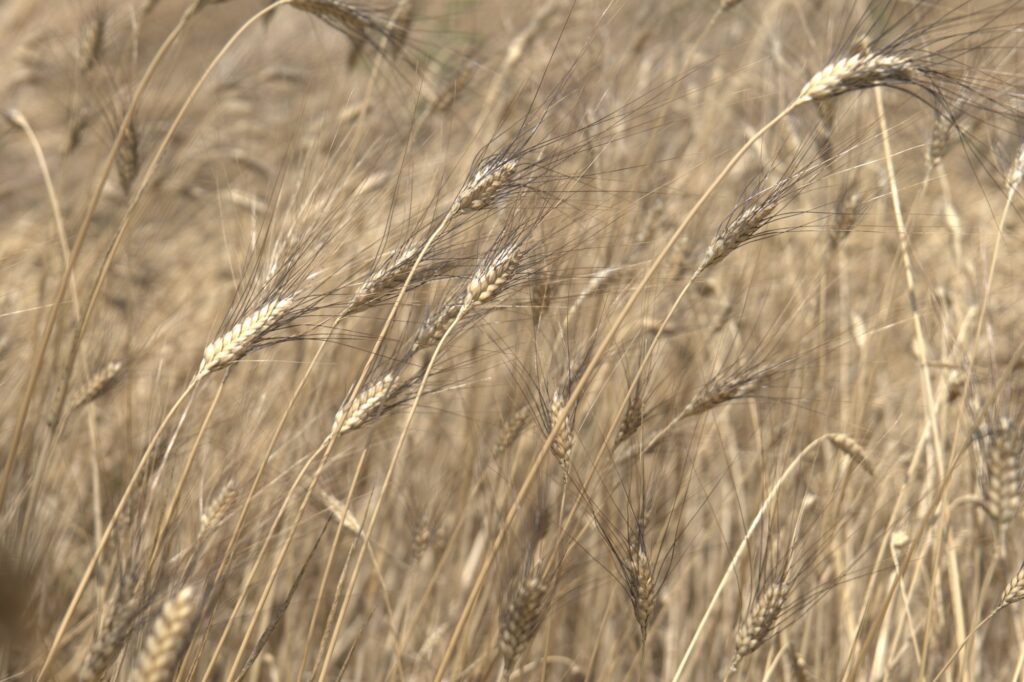
On the hills around Camporeale, next to vineyards, olive groves and almond orchards, every year we sow grains that have travelled through centuries. Some were already mentioned by the naturalists of antiquity; others were nearly forgotten in the twentieth century, when fields filled up with higher-yielding varieties. We chose to keep growing them.
We don’t do it out of nostalgia. These grains are well suited to our land, ask little of the soil and give flours with a character that modern varieties have lost along the way. Here they are, and here’s what makes them special.
Durum and soft wheat, in a nutshell
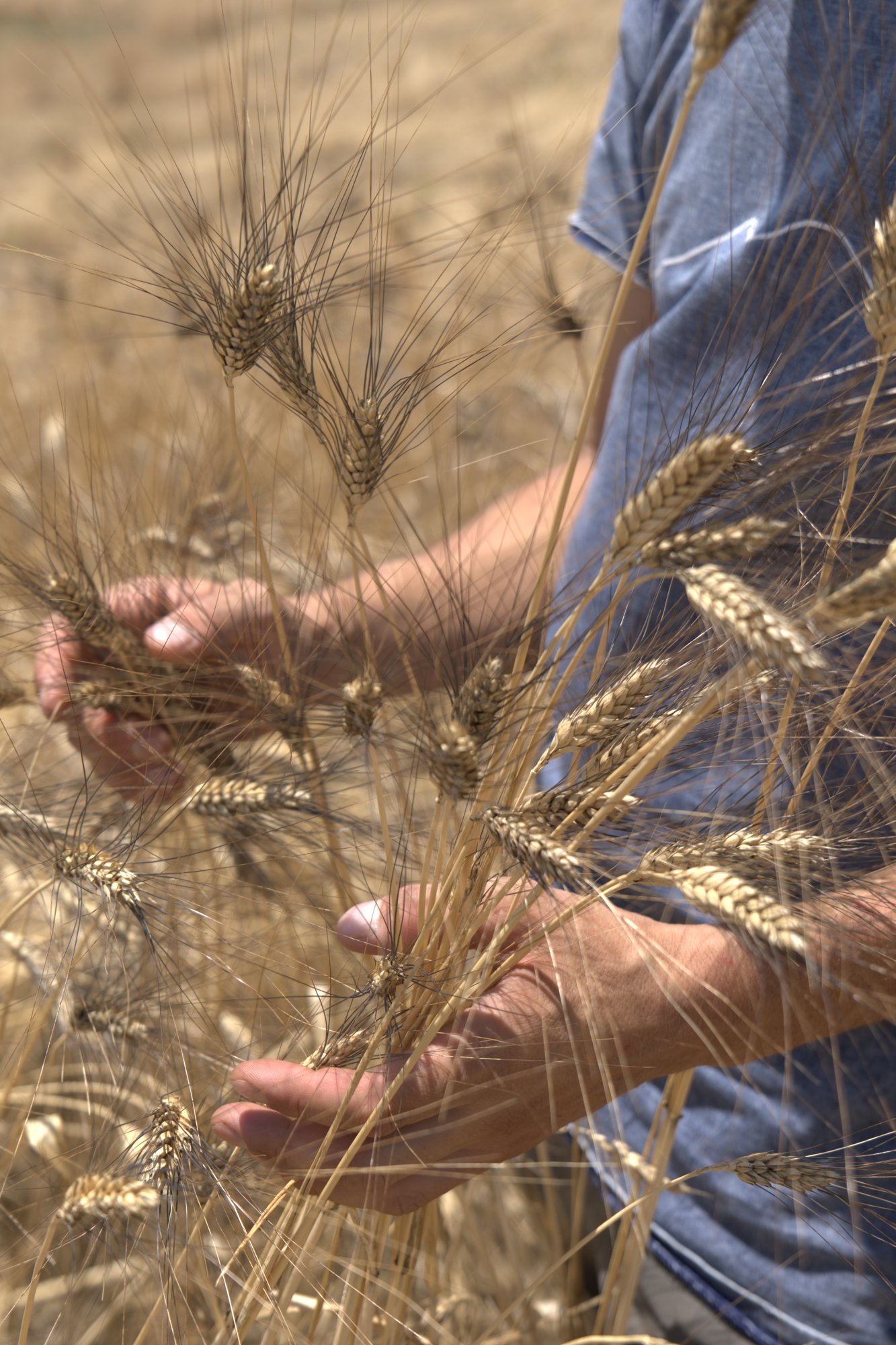
The grains we grow belong to two big families. Durum wheat has a harder, glassier kernel: it gives semolina and pasta, and in Sicily a lot of bread too. Soft wheat has a floury kernel and gives softer flours, good for pastries, pizza and bread. Among ours there are three durum wheats, Timilìa, Perciasacchi and Margherito, and two soft ones, Maiorca and the evolutionary mix.
Timilìa, the farmers’ wheat
Timilìa, or Tumminìa, is one of Sicily’s oldest varieties: Theophrastus and Pliny the Elder already wrote about it. For centuries it was the “farmers’ wheat”. It’s a late variety, so it was sown after the landowners’ fields had been worked, and the harvest went to the family’s own larder.
In the field it’s a real powerhouse. It copes well with drought, resists weeds and needs neither fertilisers nor herbicides. It’s naturally rich in polyphenols and has a very weak gluten. It was the wheat of dark, fragrant bread, the one that made the “black bread of Castelvetrano” famous.
Every year we set aside some fields to keep its seed pure, so that a heritage that has lasted for millennia keeps passing from hand to hand. Timilìa is the wheat we make our pasta with.
Perciasacchi, the kernel that pierced the sacks
Perciasacchi belongs to the Turanicum family of wheats, grown for millennia in the Khorasan region of north-eastern Iran. From there it spread across the Mediterranean and found ideal conditions in southern Italy. In Sicily it’s recorded as early as 1809. The name comes from dialect: perciare means to pierce, and its long, pointed kernel used to poke holes in the jute sacks it was carried in.
We grow it in the hills, in cool, airy fields, which allows us to use no pesticides at all, not even those permitted in organic farming. Nutritionally it’s one of the richest wheats: high in protein, low glycaemic index, minerals, vitamins E and B3 and a good amount of selenium, a mineral with antioxidant properties. It’s perfect for pasta, and we also use it for bread and pizza. For a while now you can also find it as bulgur.
Margherito, Senatore Cappelli’s twin
Margherito is the twin brother of the better-known Senatore Cappelli. Both descend from a North African population selected by the geneticist Nazareno Strampelli in 1915. It takes its name from the Margherito district near Ramacca, where it was first grown. Today it’s preserved by the experimental wheat station in Caltagirone and is listed as a conservation variety.
It holds its own against weeds and needs no fertiliser: the fertility left in the soil after rotation with legumes is enough. It gives good yields without giving up quality. From Margherito we make a twice-milled semolina with good protein content and delicate aromatic notes, excellent for both bread and pasta.
Maiorca, the cannoli wheat
For centuries Maiorca was so widespread in Sicily that it became a synonym for soft wheat. It was used almost only for sweets, and it’s said to have been the only flour for cannoli shells. Records of it go back to 1696. In the second half of the twentieth century it was nearly forgotten, replaced by more profitable varieties.
It’s a late variety that likes cool places. We grow it in the hills, where wind and moving air keep moulds away. We recommend it for pastries, but also for pizza and, blended with durum wheats, for bread.
Evolutionary mix, the wheat that adapts
The evolutionary mix (Miscuglio evolutivo) is the youngest of the family, but its roots run deep. It comes from the “Evolutionary Population” of the ICARDA centre in Aleppo: thousands of wheat varieties mixed together and then spread to many parts of the world, thanks to the work of Salvatore Ceccarelli and Stefania Grando.
Its secret is its ability to adapt. Year after year, in the field, the varieties best suited to the place prevail over the others, and the mix becomes more and more “ours”. Faced with a changing climate, it’s one of the most sensible answers we know. And it isn’t subject to royalties: it’s the free expression of the strength of seeds.
Why stone-ground
Our flours are wholegrain and stone-ground. The millstone works slowly and keeps what matters most in the grain: the germ and the bran, where fibre, vitamins and minerals are concentrated. The result is a richer, more fragrant, more alive flour.
One important note: a “weak” or “different” gluten doesn’t mean no gluten. All these grains contain it, so they’re not suitable for people with coeliac disease.
From field to table
Growing ancient wheat means working with more care, following the rhythms of the plants and the land. In return the soil stays healthier, the seeds stay free, and what reaches the table has a distinct flavour and a story to tell. Every flour, every pasta shape, every bag of bulgur is a small piece of that story.
To discover our flours and Timilìa pasta, write to us at commerciale@valdibella.com.
