

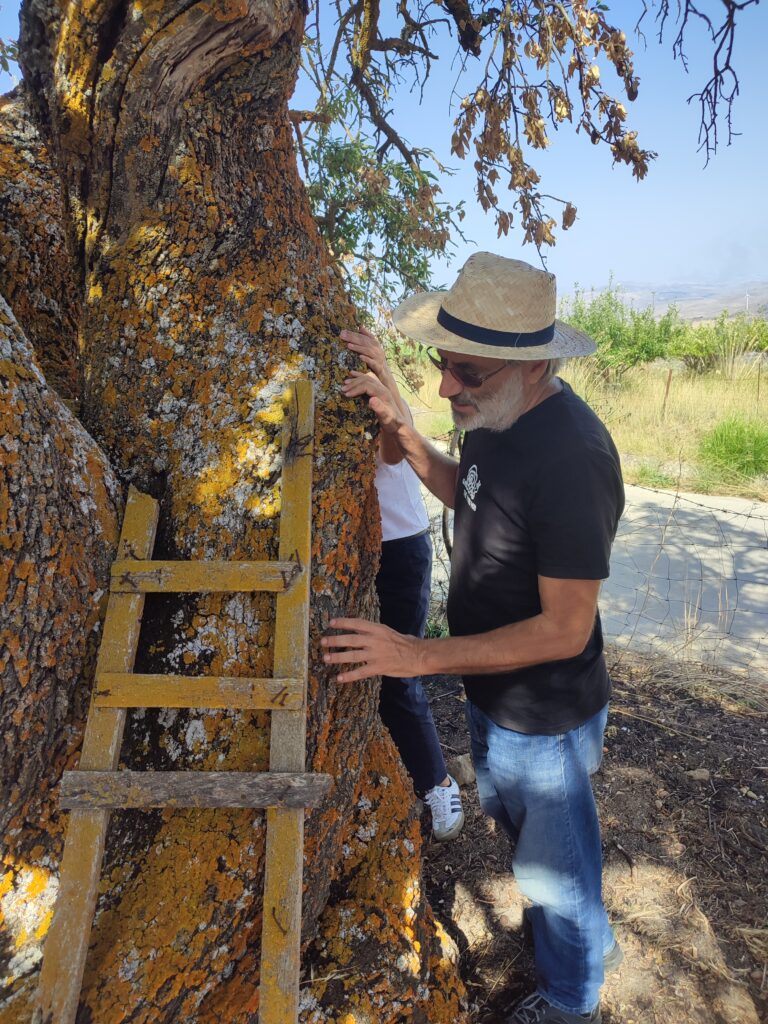
There’s a tree, in the Sicani Mountains, that as of a few days ago holds a title no other almond tree in the world can claim: it is the largest living almond tree documented so far. When the news reached us, Massimiliano and Gaspare didn’t hesitate — they went up to Castronovo di Sicilia to see it with their own eyes. Because some roots deserve to be honoured in person.
A Tree That Has Watched the Centuries Pass
The numbers alone already say a lot. Five centuries of life, ten metres in height, a trunk brushing five metres and twenty centimetres in circumference, a fifteen-metre-wide canopy, at nine hundred and ten metres above sea level. The trunk grows in a spiral and opens into three great branches, the bark is covered in lichen, and inside the wood — literally inside, absorbed by decades of growth — there are still lengths of wire used who knows when for some farming task. And then there’s her: an old wooden ladder, left embedded in the trunk, a silent witness to generations of harvesters who climbed up there to beat the branches.
It was documented by botanists Pasquale Marino and Francesco Maria Raimondo, in a study published in Quaderni di Botanica Ambientale e Applicata: its dimensions exceed those of all 39 almond trees recorded so far in the international Monumental Trees database, across seven different countries. A Sicilian almond tree that beats the world record, while an almond tree in these areas typically lives seventy, eighty years. This one has lived six times that long, and still produces its bitter almonds every year, punctual as ever.
The discovery will be presented at the International Congress of Mediterranean Botany, in late September, in Cappadocia. The mayor of Castronovo di Sicilia has already announced a protection and enhancement project: a tree like this isn’t found, it’s looked after.
A Tradition Older Than Our Memory
The almond tree, in Sicily, has never been a crop like any other. It arrived centuries ago, adapted to the island’s hot, arid climate better than almost any other fruit tree, and since then has been as much a part of the landscape as the olive or the vine — bitter almonds, sweet almonds, stretches of white and pink blossom that every winter announce the end of the cold before the calendar does.
And this is also why Italy today imports most of the almonds it consumes — from the United States, from Spain — even though the almond tree is, by vocation and by history, a plant that belongs here. A paradox that anyone who works the land in Sicily knows well: the vocation is there, written into the landscape for generations. It’s the supply chain that needs rebuilding, one hectare at a time.
That’s the work we do in Camporeale. We promote almond growing on our members’ land and complete the supply chain within the cooperative, offering our customers whole almonds for direct consumption as well as processing them into creams and almond milk. Products made exclusively with our Sicilian almonds.
Roots That Know How to Endure
The almond tree has a deep root system and modest water needs compared with many other fruit trees: it’s one of the crops best equipped to face a changing climate. But even a hardy plant has its limits, and Sicily’s recent seasons of extreme drought have shown it: when water stress becomes too intense, yields suffer regardless.
This is where native varieties come back into focus. Recovering local biotypes — those selected over centuries precisely to withstand these lands and these summers — isn’t a matter of identity for its own sake: it is, increasingly, a genuine climate adaptation strategy. Our Pizzuta and Fascionello varieties aren’t just a nod to tradition: they carry the same genetics that, according to agronomists and researchers, can help Sicilian almond growing hold up better against the climate of the coming decades.
The Castronovo almond tree, in this sense, isn’t just a botanical record for the record books. It’s living proof, five hundred years ahead of anyone else, that this plant, in this land, knows how to endure.
From the Almond Tree to the Table
Of all this, what reaches the people who choose us is the simplest part: the almonds themselves. We offer them in the shell and shelled, from which we also get our almond cream, the base for producing almond milk, for those who want them natural, crunchy and whole. From the same almond come our whole almond cream — shelled almonds, ground and reduced to a cream with the skin still on, which gives it character and an extra rustic touch, excellent at breakfast on bread or to enrich a pesto — and plain almond milk, simple and with no additions.
There’s no need to say too much about what makes almonds good for you: they’ve always been known as a source of good fats, vitamin E, magnesium, calcium, potassium, fibre and plant protein. What we like to tell instead is where they come from: from a tree that has put down roots in Sicily for millennia, and that, as the Castronovo tree shows, century after century, knows how to wait.
What Remains
Massimiliano and Gaspare came back from Castronovo with a few photos and the same feeling you bring back from a small but real pilgrimage. Nothing else was needed. A five-hundred-year-old tree doesn’t need explaining: you just have to look at it, and know that it’s still there, blossoming every winter, while everything else around it has changed.
It’s the same thing we believe in, every time we plant an almond tree we will never see fully grown: that staying, and enduring, is still the right choice.
Valdibella — Organic farming cooperative, Camporeale (PA)
